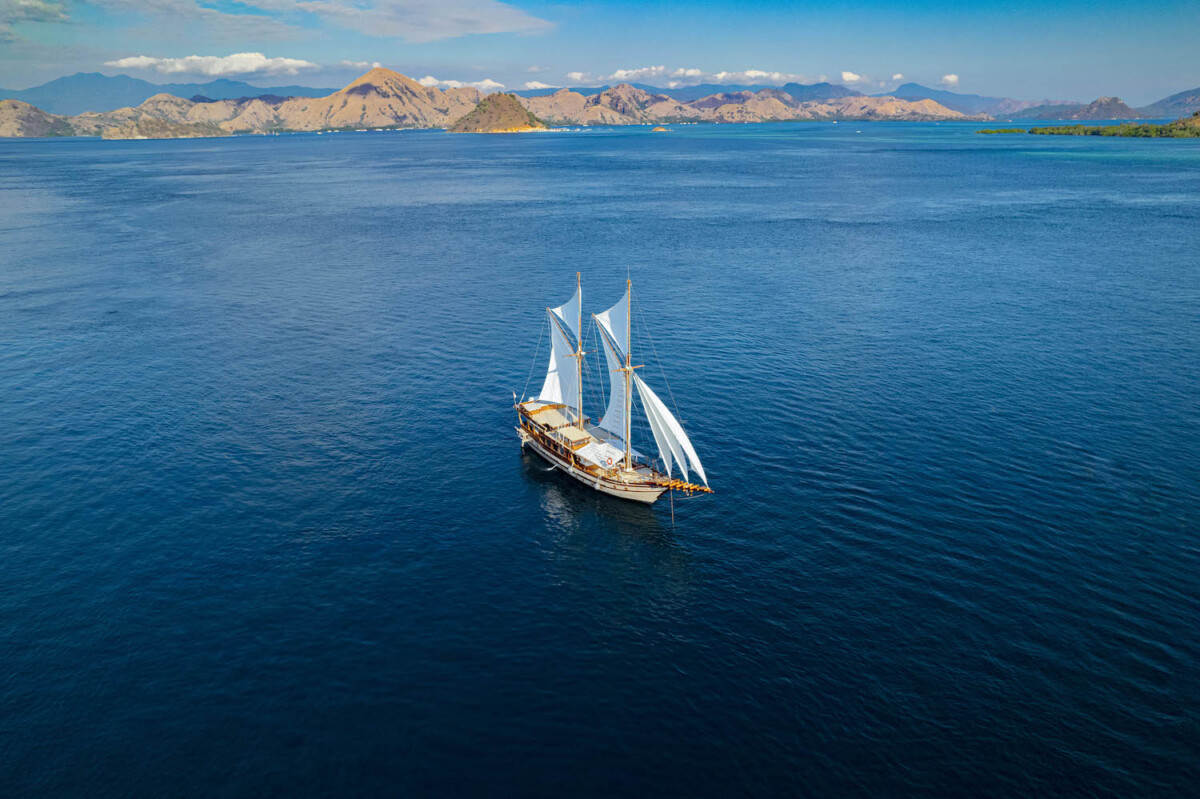
Nataraja Liveaboard offers a different way to think about island-hopping in Indonesia: not by counting islands visited, but by experiencing how the ocean changes from one place to the next.
For divers, geography is not simply a collection of beaches, viewpoints, and villages. It is a moving landscape shaped by currents, tides, underwater walls, coral gardens, visibility, water temperature, and marine life. A distance that looks small on a map can represent a completely different underwater world.
That is why traveling at “diver speed” means slowing down, looking beneath the surface, and letting the sea itself set the rhythm of the journey.
What does Indonesia look like from a diver’s perspective?
On land, Indonesia is often described as an archipelago of more than 17,000 islands. From the water, however, the geography becomes even more complex.
Two islands that appear close together may have dramatically different diving conditions because of channels, currents, depth, exposure, and seasonal weather. In Komodo National Park, for example, strong currents are a defining characteristic of its marine environment. UNESCO describes the park as an area where rich coral reefs and nutrient-rich waters support exceptional marine biodiversity.
For a diver, therefore, moving between islands is not just transportation. The journey itself is part of the experience.
A morning might begin with a drift dive through moving water, followed by a quiet reef later in the day. The landscape changes underwater long before it becomes obvious above the surface.
Why do currents matter so much to island-hopping?
Currents are effectively underwater roads.
They influence where nutrients travel, where plankton gathers, how fish move, and where larger marine animals may appear. They can also completely change the character of a dive site.
Komodo is an excellent example. The region sits between major landmasses and is characterized by strong tidal currents. UNESCO’s biosphere program records more than 260 species of reef-building coral and more than 1,000 species of bony fish in the region.
For divers, this means geography is experienced dynamically. A narrow channel is not merely a gap between two islands—it can become a high-energy underwater passage filled with life.
This is one reason a liveaboard can make sense for experienced divers: the vessel allows the journey to follow the marine environment rather than forcing every experience into a fixed land-based itinerary.
Island-hopping becomes slower and more immersive
Traditional island-hopping often asks: How many places can I see?
Diver-speed travel asks a different question: How many different underwater environments can I experience?
That shift changes the rhythm of a trip.
Instead of constantly packing, transferring, and checking in and out of accommodation, guests can use a yacht as a floating base. The boat moves while they rest, eat, photograph, or prepare for the next dive.
Nataraja Liveaboard reflects this style of travel with a 32-meter Indonesian phinisi designed for sailing, diving, and time together at sea. The yacht accommodates up to six adults and two children and sails between destinations including Komodo and Raja Ampat.
The result is less about ticking destinations off a list and more about allowing the ocean to become the itinerary.
What changes when you travel at diver speed?
The first change is time.
Divers become unusually attentive to small geographical differences. A reef facing one direction can have completely different conditions from another only a short distance away. A change in tide can alter a dive. Seasonal conditions can shift visibility and marine activity.
The second change is scale.
A conventional traveler may see a dramatic island from a viewpoint. A diver might spend 45 minutes examining a single coral wall, watching a turtle move across the reef, or searching for tiny creatures hidden among the coral.
The third is patience.
Underwater photography, marine-life encounters, and even simple reef exploration reward people who stop rushing. Instead of asking what comes next, divers often become absorbed in what is happening immediately in front of them.
Komodo and Raja Ampat reveal two different versions of Indonesia
Diver-speed travel is particularly interesting when comparing Indonesia’s major marine regions.
Komodo is known for its dramatic volcanic landscapes, strong currents, and productive waters. The national park covers approximately 219,322 hectares and encompasses both terrestrial and marine ecosystems.
Raja Ampat operates on a different scale. UNESCO’s biosphere reserve covers roughly 610 islands, atolls, and takas, with only 34 inhabited. Its waters contain more than 75% of known coral species and more than 1,320 species of coral reef fish.
For divers, these are not simply two destinations.
They represent two different ways of experiencing Indonesian geography: Komodo through currents, channels, and dramatic volcanic seascapes; Raja Ampat through extraordinary reef diversity, island complexity, and expansive marine habitats.
A yacht journey between or within these regions therefore becomes an exploration of changing ecosystems rather than simply a route between tourist attractions.
Is a yacht the best way to experience Indonesia at diver speed?
For travelers who want to spend several days exploring remote marine environments, a yacht can eliminate one of the biggest limitations of conventional travel: the need to repeatedly move between hotels and dive centers.
A private yacht or liveaboard becomes a mobile base. Diving equipment stays onboard, meals are available between activities, and the next location can be reached while guests sleep or relax.
Nataraja Liveaboard is particularly well-suited to this concept because its compact guest capacity creates a more intimate setting than that of a large cruise-style vessel. Its 7-knot cruising speed also reinforces the idea of traveling slowly rather than rushing between destinations.
For travelers considering a yacht Indonesia experience, the appeal is therefore not simply the vessel itself. It is the ability to experience the archipelago according to the rhythm of the sea.
The real destination may be the journey underwater
Indonesia is often marketed through individual destinations: Komodo, Raja Ampat, Flores, Padar, or remote islands scattered across the archipelago.
But divers experience these places differently.
They notice the current before the coastline. They remember the coral wall rather than only the beach. They measure a journey by dive sites, marine encounters, and changing underwater conditions rather than kilometers traveled.
That is the essence of traveling at diver speed.
And perhaps that is the most rewarding form of Indonesian island-hopping: not trying to see everything, but giving yourself enough time to experience what lies between the islands.